Hallmark
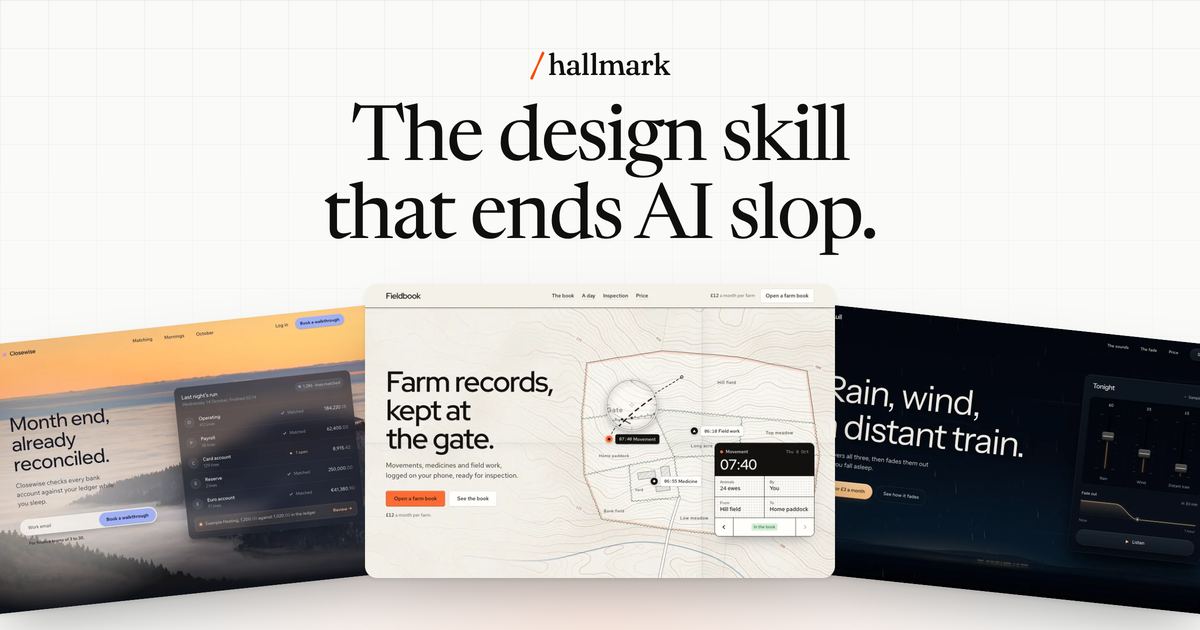
An anti-AI-slop design skill for Claude Code, Codex, Cursor and OpenCode that deals from 50 themes, renders pages in a real browser and lints the tells that make them look machine-made.
- maker
- Together AI
- stars
- 47.3K
- themes
- 50
- photos
- 755 (Wikimedia Commons)
- agents
- Claude Code, Codex, Cursor, OpenCode
- license
- MIT
- published
- 2026-11-04
- updated
- 2026-11-04
What it is
Hallmark is a design skill that plugs into coding agents and refuses to produce pages that look AI-generated. It ships as a Skill for Claude Code, Codex CLI, Cursor and OpenCode, and is made by Together AI. Instead of asking a model to "make it pretty", it deals three themes from a catalog of 50, builds the page around the visitor's job, renders it in a real browser and lints the result against known AI tells.
The problem it targets
Models converge on the same visual habits: an eyebrow above every heading, tracked-capital labels, one colored word in a headline, grids of empty frames or nothing but photos, a hero that misses the first screen, an email sign-up at the end of every page, and a form that says thanks without sending anything. Hallmark treats these as defects and blocks the worst ones.
How a build runs
- Pre-flight reads the project (fonts, palette, framework, a locked
design.md) and asks once for material: photos, screenshots, real numbers. Nothing is invented. scripts/theme.mjs dealoffers three themes that fit the prompt and clear the log;drawdeals the page's anatomy from its job.- The hero is built alone, rendered and reviewed cold before the rest of the page exists.
scripts/sloplint.mjs --renderchecks the page at eight widths, then a subagent reviews it with fresh eyes.
Each page is self-contained HTML and CSS, stamped in its first CSS comment with the decisions it took.
What's new in v2
- 50 themes. Each is a material (paper, type, color, surfaces, its own components and texture) with a picture of a finished page, and a build reads exactly one.
- Built from the job. A booking page books, a shop sells, a newsletter subscribes: the action sits where the category puts it, and the page ends on it.
- Custom. Say "custom" and Hallmark designs from your prompt alone, under the same rules and checks.
- Your real product. Point it at a URL, a dev server or an app and it captures the screenshots itself.
- Real photographs. 755 openly licensed photos, picked per subject and credited on the page.
- Redesign and audit.
/hallmark redesign <path>rebuilds a page and keeps its content and wiring;/hallmark audit <path>only reports.
The gates
The checks come in tiers:
- Floor never ships: contrast, focus, reduced motion, invented facts, a broken phone layout.
- Reflex gates are the defaults a model falls into; a build with a reason may overrule one on the record.
- Finish checks are craft detail that never blocks a ship.
Current limitations
- It is a Skill, not a page builder: you need a supported agent harness and Node 18 or later.
- Browser checks (
sloplint --render, screenshots) also needpuppeteer-coreand Chrome; without them only the static checks run. - Themes are materials, not plans, so two prompts in one theme produce two different pages; consistency comes from the material, not a fixed template.
- The 50-theme catalog and the photo library are curated opinions, not a universal design system.
- Star count and feature set are a point-in-time snapshot; the repository moves quickly.
Verdict
Primary recommendation Use Hallmark when an agent keeps producing the same generic landing page. The tiered gates and the browser lint are the useful part: they turn "looks AI-generated" into a checklist the model can fail.
Hallmark is a strong fit for developers who already use Claude Code, Codex, Cursor or OpenCode and want a repeatable taste layer without adopting a full design system. It is less useful if you need a complete component library or a visual editor.
Attribution
Made by Together AI. Source and install instructions at github.com/Nutlope/hallmark; theme gallery at usehallmark.com. MIT licensed.
Sources
- [1]
- [2]Hallmark — design taste for coding agentsTogether AI
Related cases
- → LumabookTools
- → Three.js Architecture EffectsTools
- → S.T.F.UTools