Lumabook
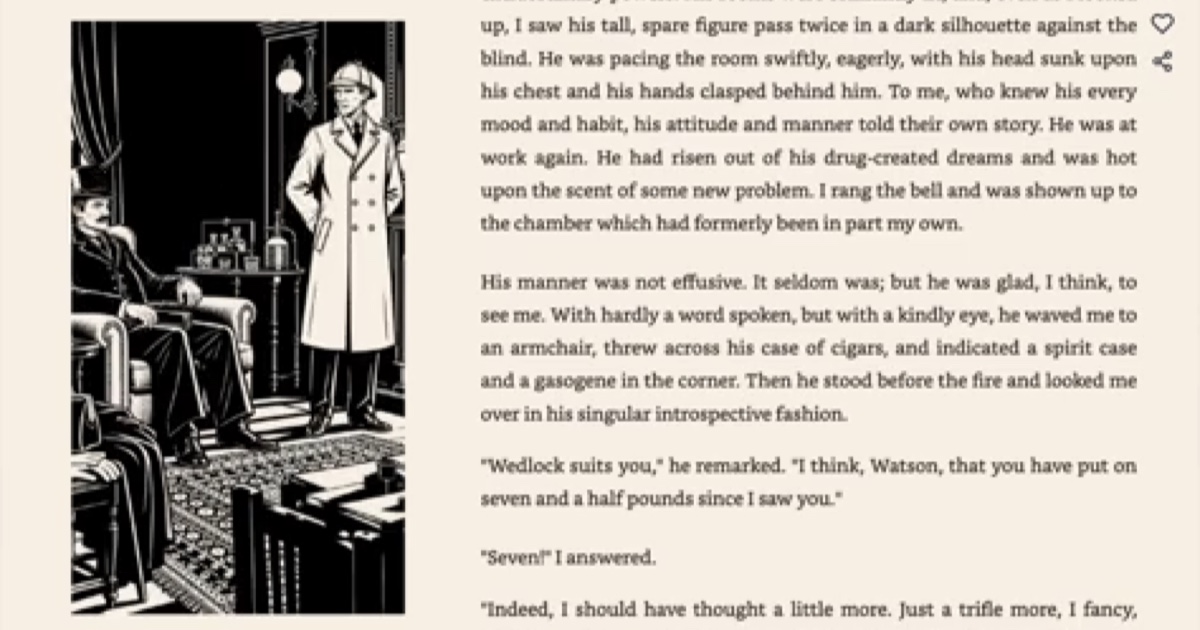
A reading app where book scenes come alive in motion as you read — starting with Sherlock Holmes, and 816 upvotes on r/SideProject.
- author
- u/yahska111
- traction
- 816 upvotes · 173 comments on r/SideProject
- first book
- The Adventures of Sherlock Holmes · public domain
- approach
- Scenes in motion as you read · not static illustrations
- known issue
- AI consistency drift (faces, clothes, locations)
- roadmap
- Inline scrolling shipped · narration mode suggested
- published
- 2026-09-26
- updated
- 2026-09-26
What it is
Lumabook is a reading app with a simple premise: you read a book normally, at your own pace, but scenes from the story come alive alongside the text — not static AI illustrations, actual motion. Built by u/yahska111 as a side project, it launched on r/SideProject with The Adventures of Sherlock Holmes as its first title, chosen because it is public domain and has an instantly recognizable atmosphere. The app is live at lumabook.ai, and the author is unusually candid about the open question at its heart: do visuals like this make reading more immersive, or just a distraction?
Core value proposition
- Motion, not stills: The differentiator against the flood of AI-illustrated books is animated scenes that live alongside the text while you keep your own reading pace.
- Consistency as the core engineering fight: The author openly treats character/clothing/location drift — generative AI's sloppiest failure — as the central problem to solve.
- Public-domain-first content: Sherlock Holmes brings a recognizable atmosphere with zero licensing risk.
- A genuine open design question: The launch invites debate instead of pretending the answer is settled — and the community's answers shaped the roadmap within days.
What it can replace
| Target software | Feasibility | Verdict & use-case context |
|---|---|---|
| Static AI-illustrated ebooks | High | Motion is the entire pitch; stills are the floor it is trying to beat. |
| Ambient/lofi visual background apps | Moderate | Several readers compared the subdued black-and-white scenes to relaxing lo-fi loops. |
| Traditional illustrated editions | Moderate | Scenes animate, but there is no artist's coherent hand — consistency still drifts. |
| Audiobook read-along apps | Low | Narration pairing was suggested by the community, not built yet. |
Current realities and limitations
- The core question is open: The author's own launch question — immersive or distracting — got a split answer, with readers noting moving visuals pull focus like movie subtitles you cannot watch and read at once.
- AI consistency drift: Faces change, clothes change, locations contradict the text; the fix (persistent character sheets, layered vectors) is discussed but not proven.
- One book: Only Sherlock Holmes exists so far; the catalog question ("which book next?") is literally the post's call to action.
- Branding headwind: Community advice included rebranding away from the
.aidomain to avoid pushback from traditional readers and literary communities.
Verdict
Primary recommendation Try the Sherlock chapter and watch your own eyes: if they keep drifting to the moving scene instead of the words, the concept is not for you — yet. The strongest signal from the launch is the audience it found: readers with aphantasia and reluctant young readers, for whom "the pictures are provided" is not a distraction but a lifeline. That is a real market hiding inside a novelty demo.
Development lifecycle and iteration loop
A solo side project that used its launch thread as a focus group:
| Stage | Tooling | Focus |
|---|---|---|
| Content | Public-domain catalog | Sherlock Holmes first: recognizable atmosphere, no licensing |
| Visual pipeline | Generative motion, consistency-first | Fighting face/clothing/location drift; character sheets and layered vectors under discussion |
| UX iteration | Reddit feedback, fast | Inline scrolling with the text already built; fullscreen, static toggles, chapter-break reveals queued |
| Positioning | Open question to readers | Immersion vs. distraction as the product's defining debate |
Metrics and monetization
- Traction: 816 upvotes and 173 comments on r/SideProject.
- Monetization: Not mentioned — the project is at feedback-seeking stage.
- Signal quality: The thread produced a concrete UX backlog (inline scroll shipped; fullscreen, toggles, narration mode requested) rather than empty praise.
Community reception and key debates
The launch thread turned into the product's design review:
- The subtitle problem: The sharpest critique likened simultaneous reading and watching to reading movie subtitles — you focus on one at a time; the counterpoint was the subdued, lo-fi-like art that sits quietly in the background.
- Aphantasia and young readers: The most durable consensus — people who do not visualize while reading found genuine value, and education/children's books emerged as the strongest use case.
- Consistency engineering: Persistent character sheets and layered vector animation were proposed as the path past generative drift.
- Branding debate: A vocal minority advised dropping the
.aidomain before courting literary communities that arrive pre-skeptical.
Sources
- [1]Lumabook — official sitelumabook.ai
- [2]
Related cases
- → Three.js Architecture EffectsTools
- → S.T.F.UTools
- → PhotonTools