Jev
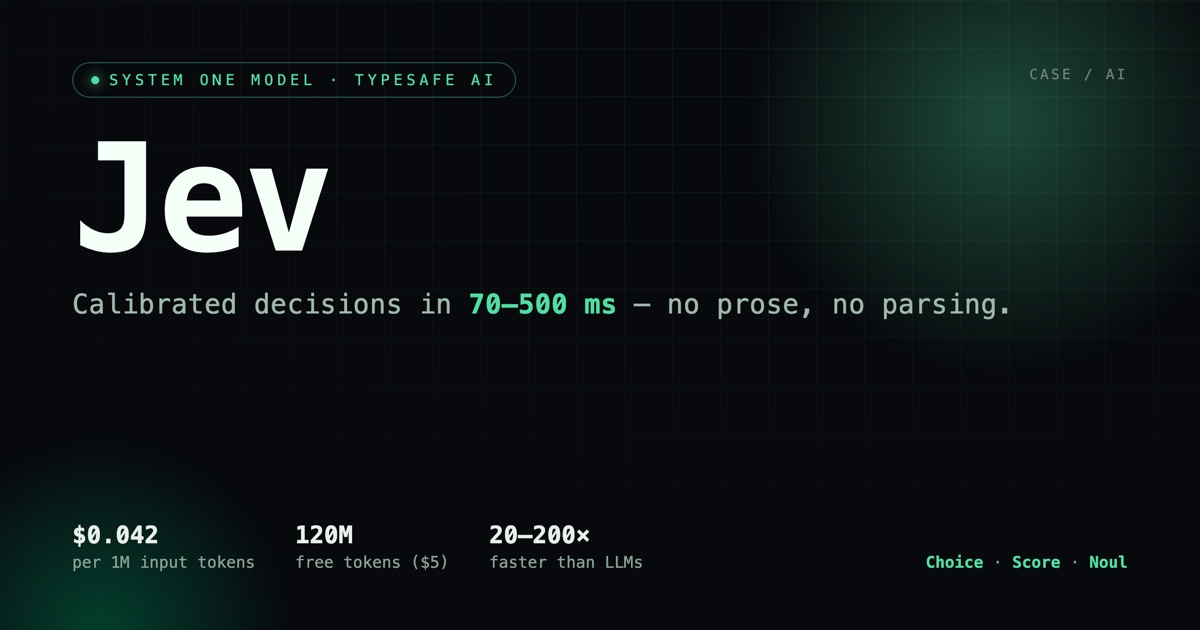
TypeSafe AI's non-generative System One model returns typed, calibrated decisions in 70–500ms instead of prose — now open to everyone with a $5 credit.
- maker
- TypeSafe AI
- founder
- Diogo Almeida (ex-OpenAI)
- latency
- 70–500ms
- price
- $0.042 / 1M input tokens (output free)
- free credit
- $5 ≈ 120M tokens
- funding
- $40M seed (DCVC)
- published
- 2026-09-20
- updated
- 2026-09-20
What it is
Jev is a non-generative model from TypeSafe AI that refuses to write prose. Instead of a conversational LLM, it takes a program state plus one or more predefined questions and returns a typed answer: an option from a list, a score, or a probability between 0 and 1, each with a confidence rating. TypeSafe calls these outputs "calibrated decisions."
The company was co-founded by Diogo Almeida, a former OpenAI researcher who worked on ChatGPT and helped develop Reinforcement Learning from Human Feedback (RLHF). After two years in stealth, TypeSafe debuted on September 15 with a $40M seed round led by DCVC and Jev as its first model. Following a waitlist period, Jev is now open to all users, with a $5 credit (roughly 120 million tokens) for every registered account.
Core value proposition
Jev trades free-form generation for strongly typed, parallel decisions:
- Typed outputs, not text: every response is a Choice (up to 255 options), a Score on a defined scale, or a Noul (a boolean assertion expressed as a probability), returned with full probability distributions and confidence scores. No JSON prompting and no output parser.
- Parallel evaluation: all questions in one request share the same input payload but are evaluated independently and concurrently.
- Speed and cost: TypeSafe reports 70–500ms end-to-end latency — 20 to 200 times faster than comparable LLMs — at $42 per billion input tokens ($0.042 per million), with output billed at zero.
- No traditional hallucination: because the answer space is defined up front, the model cannot invent details outside the predefined options, though it can still pick the wrong option.
- Real-time decision layer: in a public Ably Pong benchmark, Jev made 47 gameplay decisions in 12 seconds while Gemini, Claude, and GPT each managed only two to three in the same window.
What it can replace
| Target software | Feasibility | Verdict & use-case context |
|---|---|---|
| LLM classification and routing prompts | High | Replaces JSON-schema prompting with typed output at a fraction of the latency and cost; Vercel reported a 5–18x speedup over the ChatGPT Luna 5.6 safety classifier with higher accuracy. |
| Dedicated fine-tuned classifiers | Moderate | Competitive for many routing and scoring jobs, but teams lose control over the exact architecture and training data. |
| Dialogue, summarization, or open-ended generation | Low | Jev does not produce text; text entry in agent flows still needs a small generative model behind it. |
Current realities and limitations
- Decision-only, not reasoning: Jev answers predefined questions; it does not explain itself or handle open-ended tasks.
- Wrong answers are still possible: constraining the output space prevents fabricated details, but selecting an incorrect option within the set remains a real risk.
- The developer owns uncertainty: as Earendil CTO Armin Ronacher noted, teams must decide what to do at a 50% probability versus a 95% one, moving hallucination management into application code.
- Undisclosed architecture: TypeSafe has not published Jev's exact model architecture, and observers speculate it adapts an open-source base model.
- Capacity pressure: demand after the public launch briefly exceeded capacity and caused API slowdowns.
Verdict
Primary recommendation Treat Jev as a fast, cheap decision primitive rather than a chatbot. For routing, scoring, moderation, and agent action selection it can collapse cost and latency by an order of magnitude — as long as the developer orchestrates explicit questions in code and defines clear thresholds for acting on a probability.
Cheaper inference changes how often it is worth calling a model at all. Jev's name comes from the Jevons Paradox — as a resource gets cheaper, total consumption rises — and the wager is that near-free inference pushes intelligence into countless micro-decisions that were previously not worth an LLM call.
Development lifecycle and iteration loop
Jev is deployed by breaking a business decision into explicit questions and orchestrating them in application code, rather than hoping one prompt handles everything.
| Stage | Model / Tool used |
|---|---|
| Decision-space design (Choice / Score / Noul schemas) | Developer-authored question and option sets |
| Real-time decision inference | TypeSafe Jev |
| Orchestration, thresholds, and fallbacks | Application code (TypeScript / Python runners) |
| Free-text steps (e.g. typing a city name) | Small generative model called only when needed |
Metrics and monetization
- Funding and launch: $40M seed led by DCVC, public debut on September 15.
- Pricing: $0.042 per million input tokens, output free; new accounts receive a $5 credit worth roughly 120 million tokens.
- Reported outcomes: Vercel reported a 5–18x speedup over ChatGPT Luna 5.6 for safety classification; Bryo AI found Jev 10–20x cheaper than Gemini for business email classification at slightly lower accuracy.
- Early use: one team curated a niche content feed by evaluating eight criteria across three days of posts in two seconds for $0.007; marketing analytics teams wired Jev into the Meta Ad Library to track ad lifecycles and grade creative scripts, reporting a 30x faster workflow for under $3 total.
- Monetization: usage-based token pricing; TypeSafe says it plans specialized models for different domains.
Community reception and key debates
The launch triggered heavy discussion across the developer and AI design communities:
- Model routing as the killer app: Ronacher argued that predicting whether a query needs a frontier model is valuable but was cost-prohibitive with an LLM; Jev makes real-time intelligent routing economically viable.
- Non-generative vs. generative: developers praised the determinism and parallel speed, framing Jev as a guardrail layer for agentic architectures rather than a replacement for LLMs.
- Who manages uncertainty: the most cited trade-off is that constraining outputs pushes probability thresholds back onto the developer.
- Positioning and hype: Almeida said he does not consider TypeSafe a frontier lab — "the primary outputs of frontier labs are either fear or hype. I want our primary output to be intelligence."
Sources
- [1]TypeSafe AI ConsoleTypeSafe AI
- [2]gregpr07 on X — jev-ultrafast computer-use agent decision layerX (formerly Twitter)
- [3]tamarajtran on X — near-instant token compression with JevX (formerly Twitter)
- [4]mdlahfir on X — dynamic model routing by task complexityX (formerly Twitter)
Related cases
- → KageExperiment
- → KillMyIdeaExperiment
- → AI Fishing GameExperiment