Cinderwatch
A single-file 3D tower defense with a real autopilot: in 30 unattended minutes it wiped twice, restarted, and still reached the fifth land — with every model, texture, sound and rule inside a 1.11 MB HTML file.
- author
- Kevin Ngo (@kevin_t_ngo)
- autopilot
- 30 min unattended · 2 wipes · reached land 5, wave 23
- size
- One index.html, 1.11 MB (691 KB of it is three.js r170)
- content
- 4 towers × 3 levels · 20 monsters · 5 lands · a boss every 5 waves
- commander
- Built-in AI commander; take over or hand it back at any time
- stack
- Vanilla JS · three.js · procedural models, textures and audio · zero asset files
- license
- MIT
- published
- 2026-11-25
- updated
- 2026-11-25
Contents7 sections · 0 items
Thirty minutes with the commander in charge
I opened a fixed seed (#seed=4), left command with the AI, and used the game's own fast-forward flag to push the match thirty minutes ahead. The result is more interesting than an "AI is invincible" demo: it dies.
| Metric | Result |
|---|---|
| Time unattended | 30 minutes |
| Wipes and restarts | 2 |
| At the end | Land 5, overall wave 23, 20 lives |
| Total kills | 1,622 |
One design detail matters when reading that table: each new land resets lives and gold (300 + 80 × land index) and raises the bounty and damage multipliers. A restart is not a punishment back to wave one; it is a fresh economy on a new map. The commander is not surviving thirty minutes on one life; it died twice, and the last restart still pushed back to the fifth land.
What makes the autopilot work is also the smartest product decision in the file: the "AI commander" is not an LLM call. It is local heuristic code. The game opens from file:// with the network off, never waits on an API, and runs at 3× speed without spending a token. "AI" here is a feature description, not an inference bill.
It also makes mistakes. It leaks, it falls before the fifth land, then restarts under the same rules. That makes it a baseline you can beat, not an autopilot that finishes the game for you.
The handoff is just as literal. Your first click on a tower pad puts you in charge and the commander stops touching anything; press C or click the commander plate to hand it back. While you command, the AI does not quietly fix your mistakes.
The look: low resolution as a style, not an apology
Cinderwatch draws the 3D scene at roughly half resolution, then stacks an ordered dither, a depth-aware tilt-shift blur, a vignette and film grain on top. The result reads as a lit miniature diorama rather than a browser game. Light is the main character: the beacon, a brazier on every tower, flaming arrows, cannon flashes, chain lightning, moving shadows.
The best moment is not combat. Kill a boss and the slab you have been defending cracks apart into floating chunks, then a new battlefield assembles out of the dark with a different road and palette. It turns the level transition into the reward.
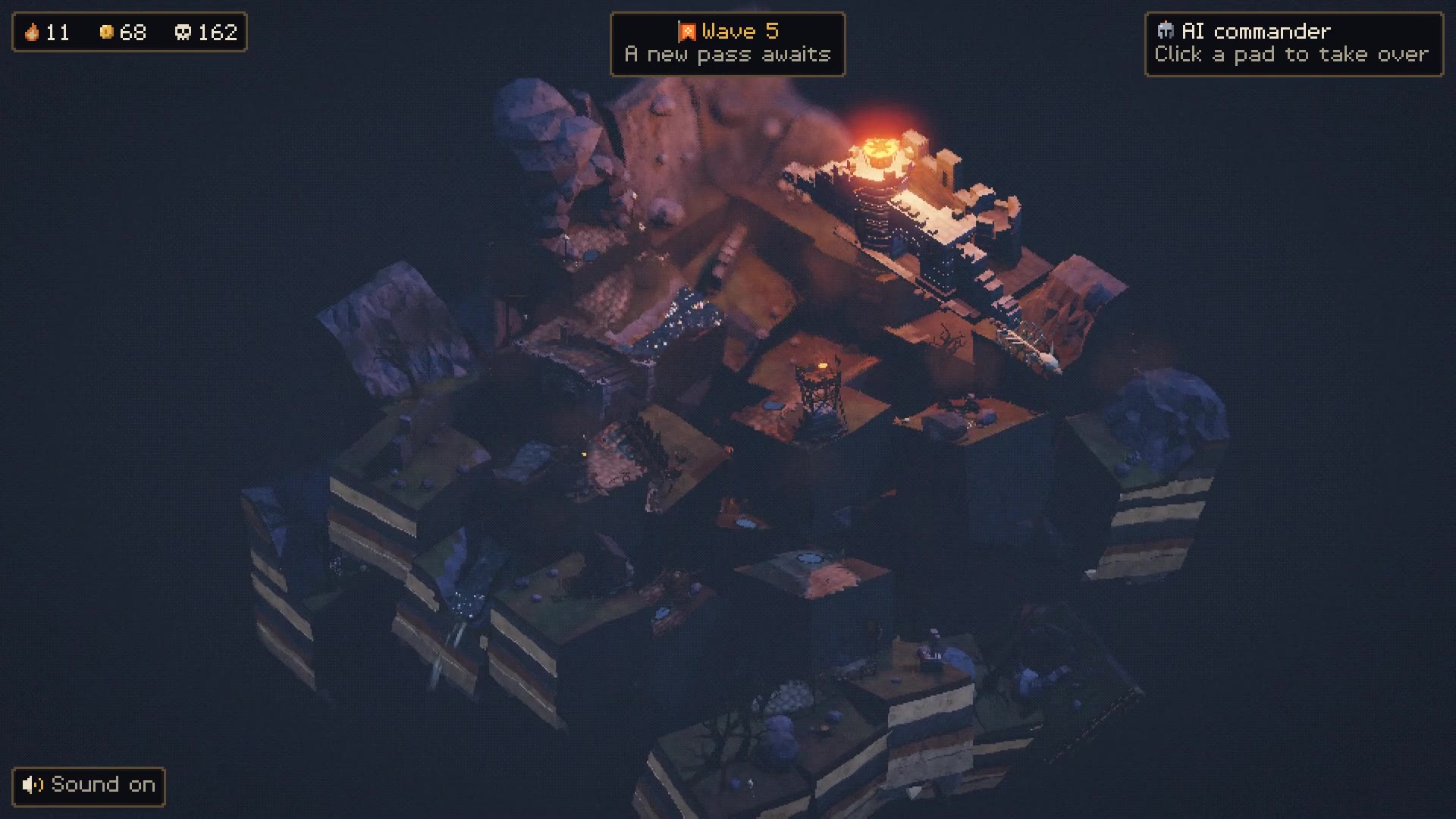
Five lands follow: Ashen Pass, Frostfall, Mirefen, Emberscar and Duskmesa.
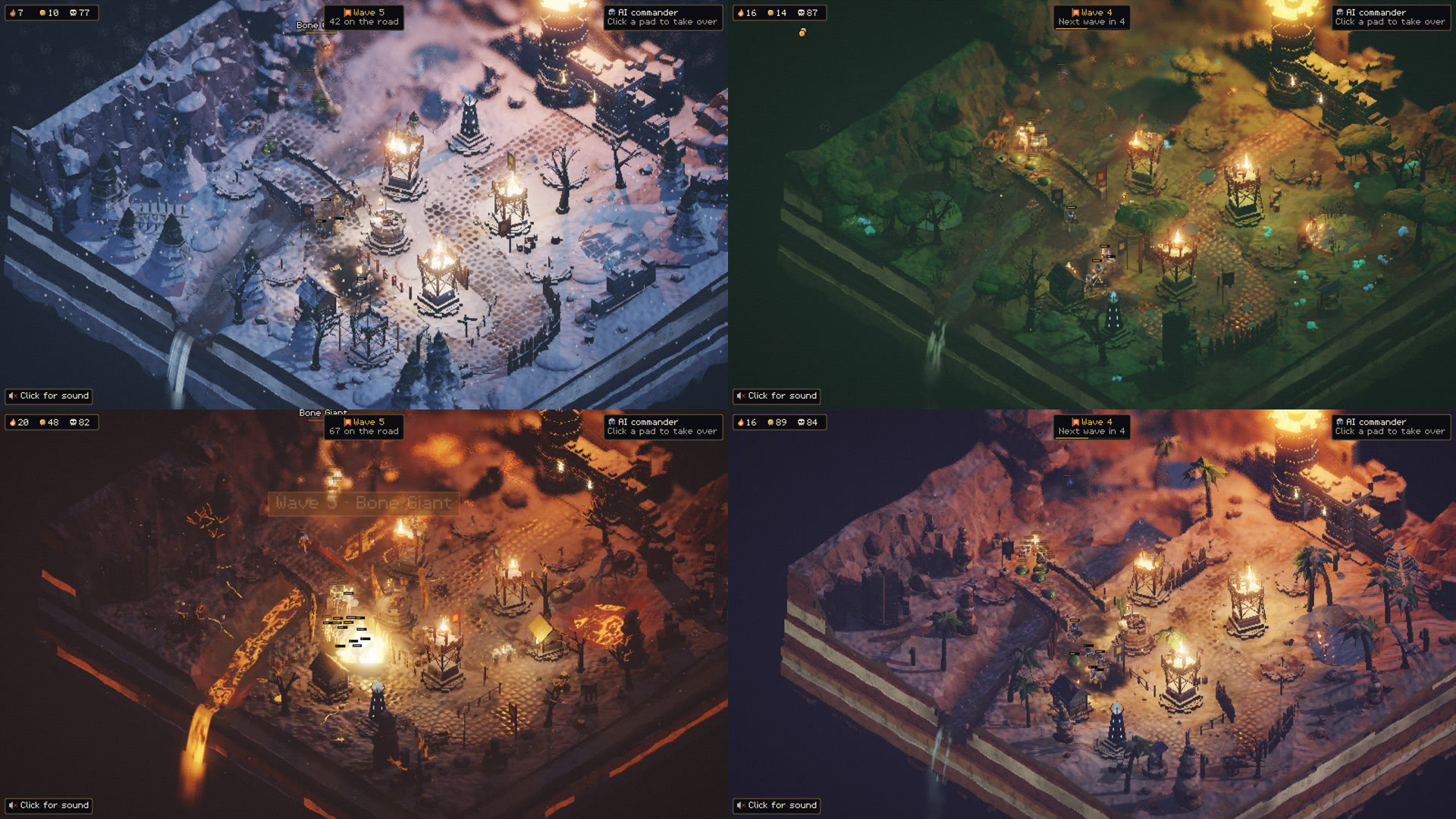
The cost of that look is legibility. Fire is almost always the brightest thing on screen, units are small, and the dither plus moving shadows can swallow the road under a busy wave. The HUD is readable — yellow pixel type on black — but it lives in the corners, so the first minute goes into finding the wave timer and the commander plate. The glowing pads help; the game still asks you to look around before it asks you to decide.
What the author got right: one file is a release format, not a codebase
The most useful fact in the repo is not the 1.11 MB. It is the source layout. index.html is built from nineteen files (00-util.js through 90-main.js) plus an inlined three.js r170, and tools/build.py concatenates them. Of the 1.11 MB, 691 KB is the library and roughly 400 KB is the game. "Single file" is what the player downloads, not how the thing is maintained.
The commit history tells the same story. The first commit lands at 06:18; the last at 15:20 the same day. Ten commits, nine hours. The messages are specific: keep the play area sharp and calm the water; add five biomes and fix the waterfall; add fifteen enemy kinds and four bosses; make the game touch friendly; make empty tower pads easy to spot; cut shadow and blur work per frame; make flyers follow the road and retune difficulty. The first generation is not the product. The nine follow-up passes are.
Three more decisions are worth stealing:
- Zero asset files. Every model, texture and sound is generated in code. Nothing 404s, nothing needs CORS, and the file opens offline. The constraint becomes the art direction.
- A commander that shares the player's API. The autopilot builds and upgrades through the same functions as the UI, so it cannot cheat and does not need a separate simulation.
- Tools for seeing and replaying. The repo ships a headless-Chrome driver (
wait,shot,eval,click,move,key, plus phone emulation) and a fixed 1/60 s recorder keyed to a seed. URL flags (seed,biome,level,k,ff,fps,nodof,noopt,manual) make a run reproducible. That is the difference between "it looked fine when I tried it" and being able to iterate.
Where I would mark it down
The commander has a ceiling, but the game does not turn it into a target. It wiped twice and peaked at wave 23 in half an hour. That is a ready-made rival; yet the HUD only remembers your best wave. No "beat the commander" marker, no record of which lands you cleared, no daily seed. The hook exists; the meta layer does not.
Once you take over, the board still withholds information. Fire, dither and small units keep the road busy; mid-wave, it is hard to see which tower covers which stretch. The range preview helps, but there is no "this is the one that will leak next" signal. First-time players learn by trial.
The mobile claims are still unproven. The README is honest: touch was tested in Chrome's phone emulation, not on real phones, and gamepad input was never tested on hardware. Pinch zoom, long presses, safe areas and a 1.11 MB first parse on a low-end Android are exactly the things an emulator cannot settle.
Who should open it
- Single-file builders: read
tools/build.py, the post-processing chain and the recorder before you screenshot the result. - Product people adding a "demo mode": this is a clean example of an autopilot that is real, local and free to run.
- Three.js learners: procedural geometry, dithered post-processing and a deterministic seed loop in one readable MIT repo.
- Casual players: the first three minutes are genuinely delightful.
- Meta-progression hunters: wait for daily challenges or a scoring ladder.
The verdict
One line Cinderwatch turns "single file" from a stunt into a distribution strategy: keep the complexity in the source, hand the player a double-click.
The deduction The look and the autopilot are strong hooks; the long game has not caught up. The commander gives you a baseline to beat, but the game never frames it as a rivalry — so taking over still feels optional rather than urgent.
Reception
The author's release post drew 1,811 likes and about 93,500 views; CF长风's Chinese recommendation added 547 likes and 44 replies. GitHub reached 100 stars and 27 forks within a day, under MIT. fablelist ranked it 13th of 116 games by likes; VibeGamer lists an average session of three minutes. That average sits oddly beside a 30-minute autopilot: the game can hold the screen far longer than most sessions last.
The replies are mostly some version of "incredible — now give me fourteen of those" (dan build) or "looks great!" (Silicon Jungle). Almost everyone talks about the format and the look. Almost nobody talks about what you do on day three. That is both the achievement and the next problem.
Sources
- [1]Cinderwatch — play in your browserGitHub Pages
- [2]
- [3]
- [4]
- [5]Cinderwatch on fablelistfablelist
- [6]Cinderwatch on VibeGamerVibeGamer
Related cases
- → Codex: C4D vs BlenderExperiment
- → Getting ThereExperiment
- → PapertrailsExperiment