Crimson Loong: Two Dragons in One HTML File
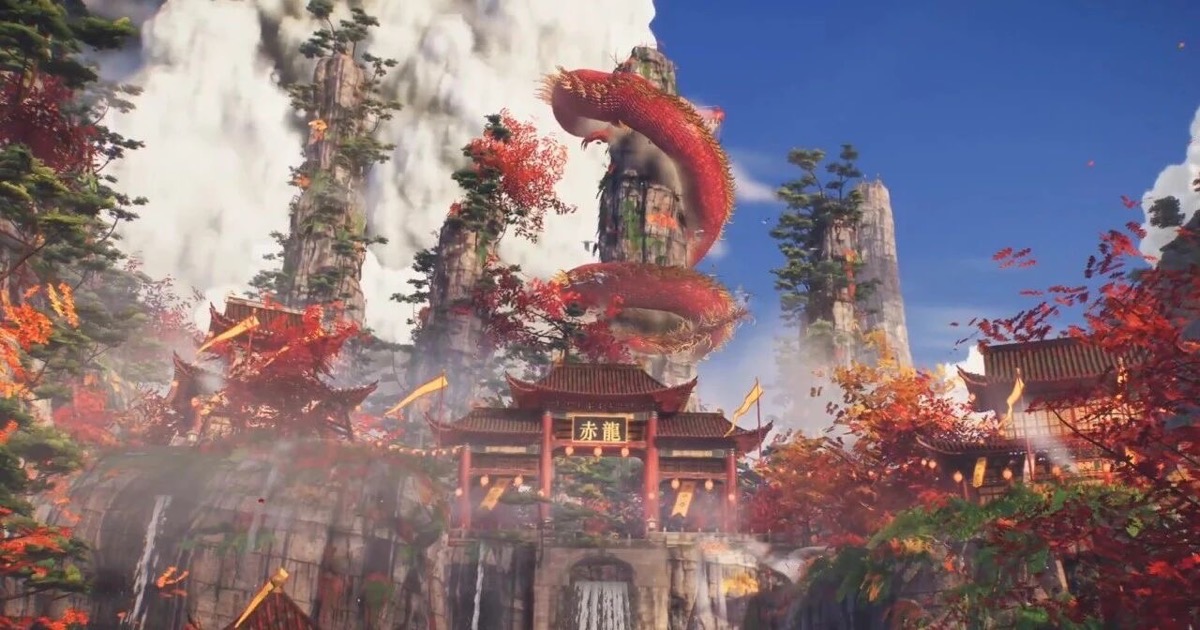
Fable 5.2 wrote a 90-second Chinese dragon film in three.js — a crimson loong coiled on a karst spire, a white one pouring out of a storm. The whole thing is one 1.92 MB HTML file, with every mesh, texture, shader and note generated by code at load time.
- model
- Claude Fable 5.2 · Anthropic
- deliverable
- 1 HTML file · 1.92 MB · 90 s · loops
- assets
- 0 images · 0 models · 0 audio files
- library
- three.js r180, inlined into the page
- sound
- Synthesised in a Web Worker → Web Audio API
- scene
- Autumn valley · red maples · vermilion halls · karst spires
- source
- 1.23 MB of source · 18 scripts · 1 build command
- performance
- 60 fps on an Apple-silicon laptop GPU, up to 3.7 MP
- previous
- v1, 60 s with one dragon · 0.88 MB
- published
- 2026-11-16
- updated
- 2026-11-22
Contents8 sections · 0 items
One crimson dragon, one white, all inside a browser
The film started as a post going around online: Fable 5.2 had done this in three.js, with no external assets of any kind.
Open the link, click once for sound. A crimson loong lies coiled around a karst spire, its tail wrapped twice, the scales going red in the afternoon light. The valley is in autumn — red maples, vermilion halls, waterfalls, stone spires rising out of the mist. A white loong pours out of a storm cloud. The two fight across the sky, collide, fall into the lake together, then rise around a pearl. Ninety seconds, and it loops back to the start.
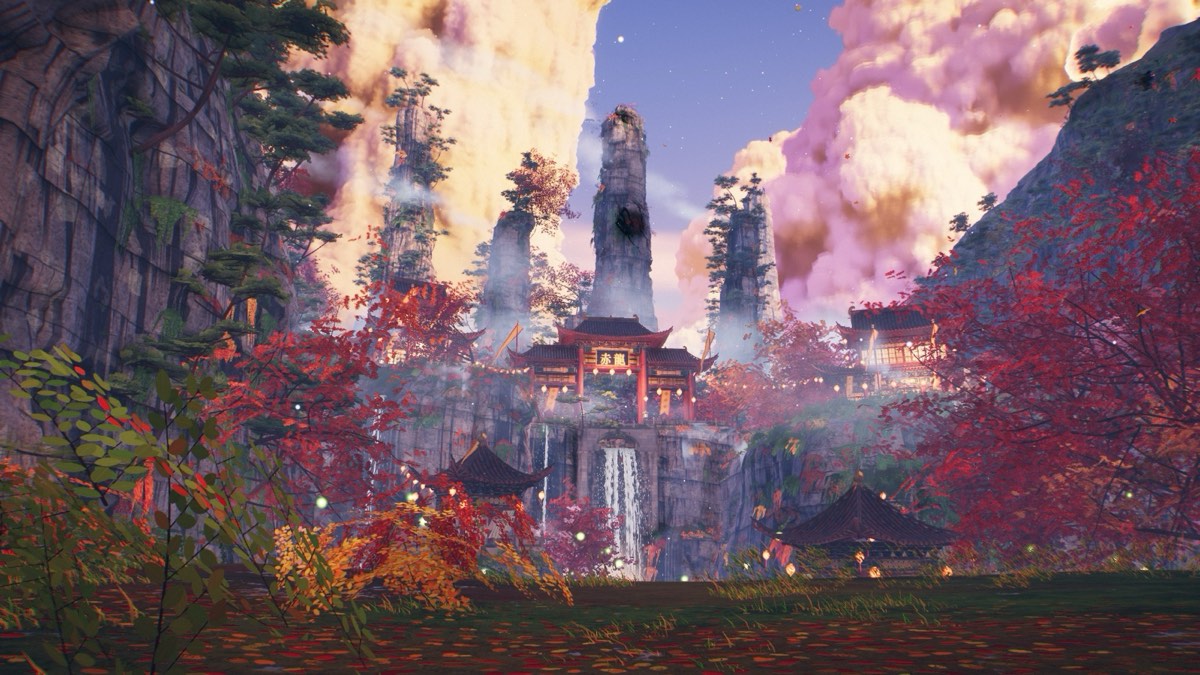
The first thing you see. The clouds in the distance are volume clouds baked by ray marching; the maples in the foreground swing each in its own way.
This is not a pre-rendered video. The whole piece is a single HTML file, 1.92 MB. Download it, double-click, and it opens from your local disk — and after that it never makes a network request. three.js r180 is inlined into the page. No loaders, no post-processing package, no physics engine, no audio library.
The README is blunt about it: there is not one image, model, font, HDRI or audio file in the page; no data: URIs, no loader in use. Every mesh, texture, shader and note is computed when the page loads. Sound is synthesised in a Web Worker and played through the Web Audio API.
Open the file up and there are eighteen scripts
The 1.23 MB of source is not stuffed into one file. src/ holds 18 plain JS scripts, concatenated in filename order, and python3 tools/build.py inlines three.js plus the source into a single HTML. With three.js inlined, the built page is 1.92 MB.
| Script | What it builds |
|---|---|
20_sky.js |
Ray-marched cumulus baked into drifting layers, the storm, the rift, rain |
30_rock.js |
Karst spires and cliffs from displaced parametric surfaces |
35_arch.js |
Gate, halls, pavilions; lanterns rigged as pendulums; cloth |
40_flora.js |
Maples, Huangshan pines, shrubs, grass, cliff plants |
60_dragon.js |
The dragons: scale shader, heads, manes, wetness, paths and poses |
66_wake.js |
How plants, dust and stones answer a passing body or a shock front |
68_water.js |
Lake with a planar mirror, current, falls, bow sheets, the splash |
70_fx.js |
Fire, frost, lightning, beam, blast, spray, shed water |
72_air.js |
Flowing mist, birds, leaves, smoke, fireflies, gust fronts |
80_post.js |
HDR target, ambient occlusion, bloom, grade, lens |
85_audio.js |
The score and every sound effect, synthesised |
88_film.js |
Beat sheet, camera, wind |
What is worth studying is the cut: sky, rock, architecture, flora, dragons, water, effects, air, post, sound — one file each, no trespassing. The README gives that cut an engineering rationale: everything on screen is a pure function of film time, so any frame can be rendered on its own, or out of order. Effects that need memory — rings on the lake, torn leaves, lanterns still swinging — read from tables built once at load.
That constraint sounds like fussiness. It is the reason the film holds together for 90 seconds.
The comments exploded first
The post passed a hundred thousand views within a day. The dominant reaction was shock: "What did I just watch?" "Completely insane." "What the hell is Fable 5.2 doing with three.js?!" — that last one in all caps.
Most people fixated on the zero-assets part. This was not calling a ready-made 3D model library; it was forcing the model to build everything out of plain code. Someone joked that at this rate a few more prompts would reproduce Black Myth: Wukong. Others asked about cost and guessed "this must have burned a billion tokens" — that was a guess. The author never published a number.
The half the author added later matters more
In replies, the author filled in the process. He generated reference images in Midjourney first, had the model rebuild them as a scene in JS, then iterated. He also ran multiple agents, with a shared "message board" so agents could call each other's finished work and save tokens. The whole thing was a long series of loops, not one generation.
That half pulls the "one prompt, one film" story back to earth. The film is genuinely good, but it did not grow out of a prompt in one pass. It was assembled in layers: reference images to set the art direction, agents splitting the modules, a human looking at it and sending it back. Fable 5.2's role here reads more like a patient implementer than a director.
Consistency is harder than one dragon
The calmer comments went straight to the real difficulty:
The hard part is self-consistency
Plants, buildings, dragon scales, water reflections, wind — all of it has to live under one set of rules. That is much harder than generating a single beautiful object.
The source shows how they handled it. Wind is not written ten times in ten places; it is one shared shader chunk in 05_glsl.js that sky, flora, water and banners all reference. Fog and aerial haze are the same. When a dragon passes, how the grass bends and how dust and stones lift is handled centrally in 66_wake.js. So a single flyby bends the treetops, kicks up leaves and leaves a ring on the lake — three effects that line up because they read the same event, not because someone animated them to match.
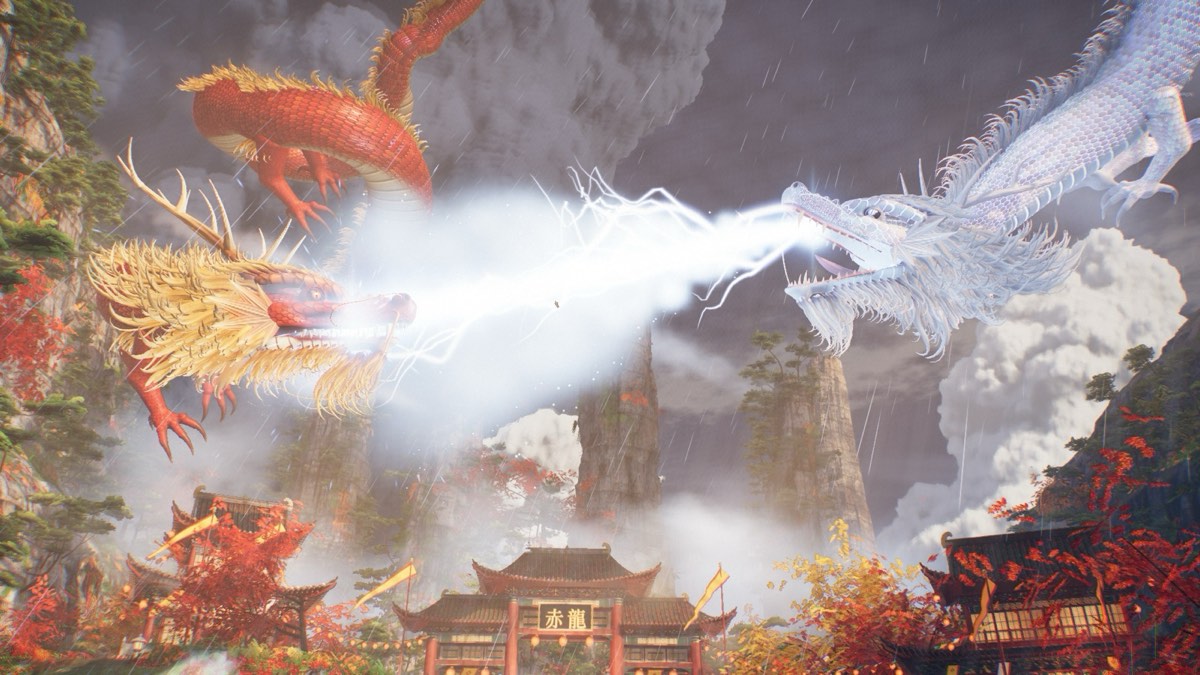
The duel. The red scales and the white scales are two materials, but the rain, the lightning, the mist and the light on the spires come from one system.
What it proves, and what it doesn't
What it proves: AI code generation has moved past "write a function" and "write a small tool." It can now work for a long stretch and deliver a complete, self-contained 3D short — and it took the hardest route on purpose, with zero external assets. Fable 5.2 is positioned for long-horizon agentic work, and this film lands squarely in that target.
What it doesn't prove needs saying too:
- This was not one prompt. Midjourney references, multi-agent orchestration and repeated loops are human work.
- One demo is not a benchmark. Nobody ran the same prompt a second time, and nobody compared models.
- The frame rate belongs to one machine. The README's 60 fps is an Apple-silicon laptop GPU at up to 3.7 megapixels, and the page lowers its internal resolution when a frame runs long. The author doesn't say how it runs on a phone.
- Cost is unknown. The "billion tokens" figure in the comments is a guess; no bill was published.
- Watching the film is not reading the code. Ninety seconds can look great, but how much of it was hand-tuned only shows up in the source.
Watch it, or take it apart
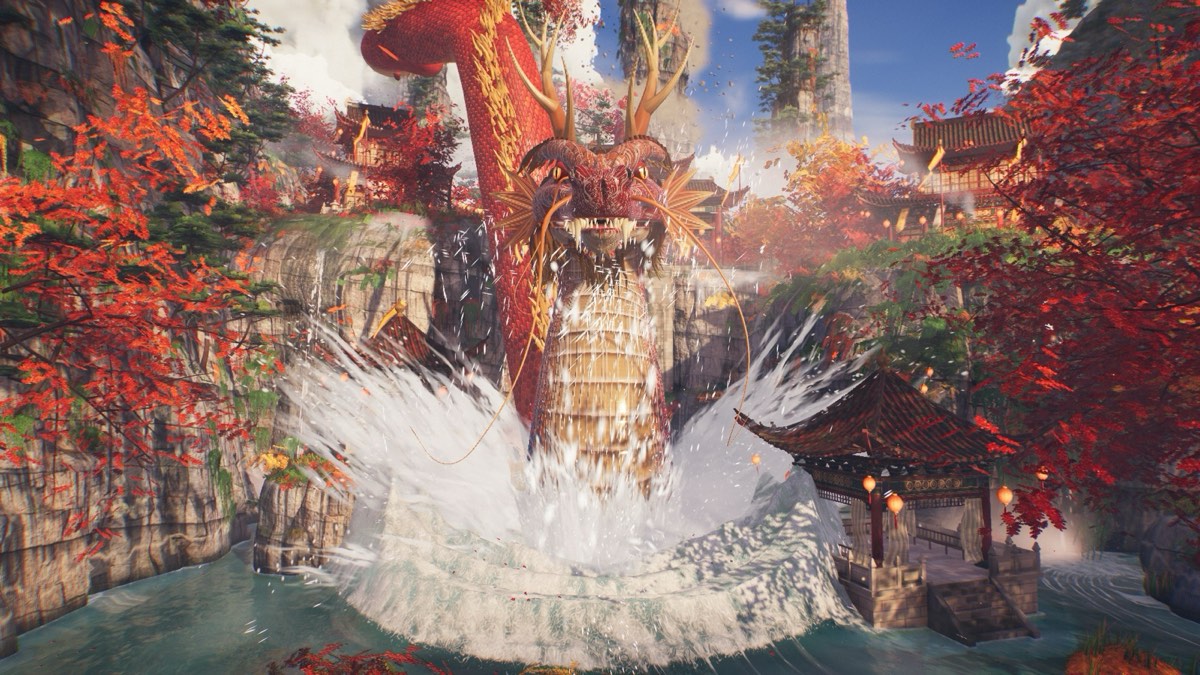
The dive and the rise. The water breaking is 68_water.js, the spray it throws is 70_fx.js, and both sit on the same timeline.
- Watch online: chetaslua.github.io/crimson-loong. Click or press
Mfor sound,Spacepauses picture and sound together, and moving the pointer nudges the camera. - Run it locally: download
index.html, open it in a desktop browser with WebGL 2. It works fromfile://. - Compare with v1:
v1.htmlis 60 seconds, one dragon, 0.88 MB. Put the two side by side and you can count what went into the second dragon. - Build it yourself:
python3 tools/build.py.tools/still holds the rig used while making the film — headless-Chrome frame capture, score export to WAV, a frame-cost probe, an image diff.
If you only read three things, read them in this order: the beat sheet in 88_film.js (the film's rhythm is literally a timetable), then how 60_dragon.js paints scales in a shader, then how 85_audio.js synthesises an entire score and every effect with no audio file anywhere.
Credits
Compiled from the 2026-11-16 article "只用Three.js,一个HTML文件造出双龙缠斗,Claude Fable 5.2炸场全网" by SuperMMM on the WeChat account 初识Threejs. Crimson Loong (赤龍) was made by ChetasLua; the source and all stills are public on GitHub, and three.js is MIT-licensed. The three stills here come from the project's stills/ folder and the cover is the original video's first frame; rights remain with the authors.
Sources
- [1]
- [2]
- [3]Watch it live (click once for sound)GitHub Pages
- [4]three.jsthree.js
Related cases
- → Codex: C4D vs BlenderExperiment
- → Getting ThereExperiment
- → PapertrailsExperiment